
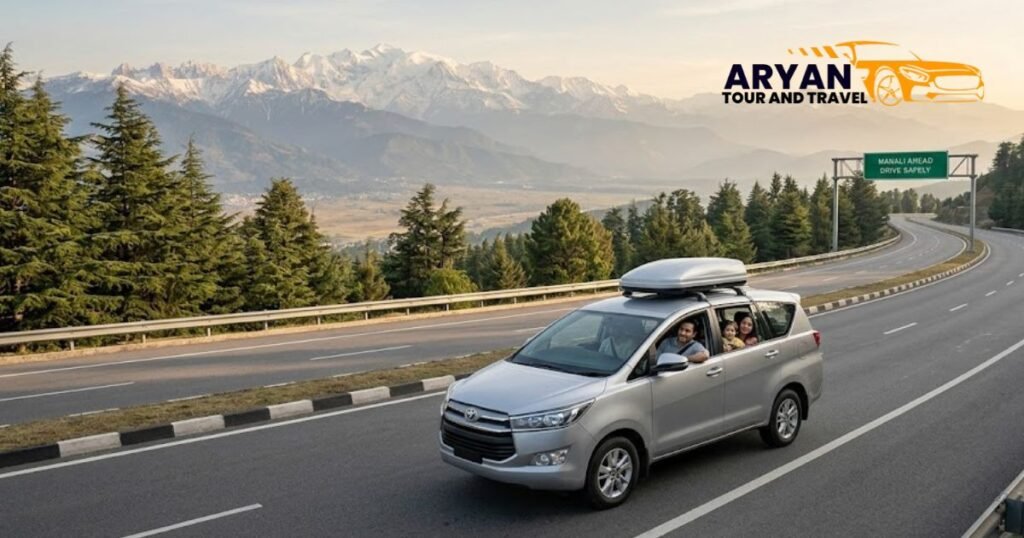
The 270-kilometer route from Chandigarh to Kullu and Manali is a primary travel corridor in northern India, connecting urban areas to high-altitude hubs along the Beas River. This region is a central location for trekking, winter sports, and wellness tourism. Navigating the drive involves managing significant elevation changes and variable weather conditions. While public luxury buses are available, they operate on fixed schedules and offer limited flexibility. Choosing a private taxi service for the journey provides a more adaptable alternative. This option allows for a more controlled environment and an itinerary tailored to specific needs, prioritizing safety and comfort throughout the transit.
1. Safety and Comfort: The Intertwined Pillars of Mountain Transit
When evaluating outstation travel through mountainous terrains, safety and physical comfort cannot be viewed as separate entities. They are fundamentally co-dependent. Winding high-altitude expressways present unique physical challenges—including sustained G-forces from continuous hairpin bends and rapid barometric pressure drops that quickly compound the effects of travel fatigue and motion sickness. In a crowded public coach or a poorly maintained local cab, these variables frequently lead to physical exhaustion well before you reach your destination. A premium private transit experience addresses these physiological challenges through advanced vehicle mechanics and isolated cabin environments. By reserving an exclusive chandigarh to manali cab, passengers gain total sovereignty over their immediate travel ecosystem. Modern outstation fleets feature sophisticated multi-link suspension systems, optimized body-roll control, and advanced climate control systems that keep the cabin pressurized and fresh. Furthermore, the isolation from public crowds provides an environment where corporate executives can maintain absolute productivity, while families can rest undisturbed. Most importantly, a private transfer offers the luxury of responsive time management allowing passengers to pause transit at verified highway plazas to stretch, adjust to altitude shifts, and maintain physical equilibrium throughout the journey.
2. Technical Insights into the Modern Kiratpur-Nerchowk Infrastructure
The operational profile of the Chandigarh-to-Manali highway network has undergone a profound structural evolution. Historically, traversing National Highway 21 (NH21) meant enduring an exhausting 8 to 10-hour trip characterized by narrow double-lane segments, heavy commercial bottlenecks, and slow ascents through congested municipal zones. The opening of the state-of-the-art Kiratpur-Nerchowk section along the Himalayan Expressway network has completely modernized this logistical pipeline. This modern multi-lane expressway bypasses traditional bottleneck sectors entirely through an impressive network of engineered flyovers, reinforced valley bridges, and strategically bored mountain tunnels. These lit, ventilated tunnels cut directly through the rugged topography of the Bilaspur and Mandi districts, effectively eliminating exposure to old, landslide-prone cliffside bypasses. The integration of these infrastructural upgrades reduces overall transit time from Chandigarh to a highly predictable 5 to 6 hours under standard driving conditions. The road grade is meticulously calculated to minimize steep vertical climbs, ensuring that vehicles maintain smooth, high-efficiency cruising speeds while providing passengers with panoramic views of the Govind Sagar reservoir and the Pandoh Dam corridor in absolute safety.
3. The Financial Engineering of Point-to-Point One-Way Logistics
For decades, the outstation car rental sector in northern India operated on a rigid, two-way pricing paradigm that penalised linear, single-direction travelers. Even if a passenger only required a direct drop-off to check into an extended corporate retreat, wellness sanctuary, or a long-term remote work station in Manali, traditional vendors would mandate a comprehensive round-trip fee. The legacy justification focused on the vehicle’s empty return leg back to its primary base in the plains. Modern centralized fleet dispatch networks and automated vehicle routing have completely shifted this paradigm in favor of the corporate and leisure consumer. Establishing a dedicated one-way booking utilizes advanced point-to-point linear billing. Passengers are explicitly invoiced for the exact distance tracked from their specific pickup address in the Tricity straight to their final destination gate in the hills. This modern pricing architecture completely eliminates return empty-leg surcharges, instantly capturing up to 50% in travel cost optimizations. This represents a highly efficient allocation of travel capital for digital nomads, international tourists embarking on open-ended Himalayan expeditions, or corporate groups with independent return logistics.
4. Mountain Geography: Understanding the Route Disruption Zones
A truly informative planning guide must look closely at the geographical realities of the outer and mid-Himalayan ranges. The route from Chandigarh scales across varying altitudinal zones, meaning the vehicle encounters distinctly different geological conditions within hours. The initial stretch across the Himalayan Expressway offers stable four-lane cruising. However, as the vehicle passes the Swarghat segment and approaches the Mandi-Pandoh corridor, the rock formations change from compacted soil to fractured shale and limestone. This makes the zone structurally sensitive to heavy monsoons or sudden seismic shifts. A professional taxi service mitigates these environmental risks by deploying drivers who act as practical geologists on the road. They understand how to scan cliffside canopies for falling debris, recognize early warning signs of minor shifting rock faces, and map out alternative state highway bypasses through the interior hills if a main highway artery faces a temporary structural block.
5. Defensive Driving Protocols for High-Altitude Corridors
Navigating mountain expressways demands a technical driving skill set that standard urban operations simply do not require. The sharp curves past Mandi, unpredictable low-lying cloud cover, and sudden valley downpours present fluid hazards that require seasoned expertise. Professional outstation transit providers enforce rigid defensive driving protocols. Chauffeurs are explicitly trained in mountain physics specifically mastering the art of engine braking (using lower gear ratios to control vehicle descent velocity rather than riding the friction brakes, which causes brake fade and thermal failure). Vehicles must maintain extended trailing distances to account for variable traction on wet surfaces, and speeds are strictly regulated below designated thresholds to guarantee absolute vehicle control at every blind corner.
6. Elevate Your Journey with Aryan Tour and Travel
Executing a perfectly seamless, safe, and elite highway transfer requires an operator that treats travel hospitality as a precise science. At Aryan Tour and Travel, we have built our professional identity on providing premier, stress-free intercity logistics across northern India.
When you secure your private taxi from chandigarh to manali through our corporate reservation platform, your asset protection, physical comfort, and scheduling integrity are backed by audited standards of excellence:
-
Certified Mountain Chauffeurs: Our driving professionals undergo comprehensive background verification, health screenings, and routine assessments in defensive mountain driving. They possess years of experience navigating the specific terrain of the Kullu Valley under all seasonal variations.
-
Absolute Billing Transparency: We maintain an unyielding policy of zero hidden surcharges. Every contract provided by our desk is fully inclusive of all fuel overheads, professional driver night allowances, state border entry permits, and automated national highway Fastag toll fees. The initial locked quote is the exact final figure you pay.
-
Rigorous Mechanical Stewardship: Safety is governed by strict preventative maintenance. Every vehicle in our modern fleet is subjected to a comprehensive multi-point inspection evaluating brake pad thickness, steering rack responsiveness, suspension bushing health, and tire tread depth prior to being dispatched for service.
Frequently Asked Questions:
1. Are all national highway tolls and Himachal state border taxes completely integrated into the initial quote?
Yes, our pricing architecture is fully transparent. The comprehensive rate confirmed at the time of reservation explicitly integrates all national highway automated Fastag toll assessments, Himachal Pradesh state border transit entry taxes, fuel overheads, and driver night fees. There are completely zero secondary or unlisted surcharges applied at your destination drop point.
2. Can we arrange an immediate, punctual pickup directly from the Chandigarh Airport arrivals terminal?
Yes, we specialize in high-efficiency airport and railway station transfers. Our chauffeurs coordinate directly with real-time flight telemetry tracking, ensuring that whether your flight arrives ahead of schedule or faces a midnight delay at Chandigarh International Airport (IXC), your private car and driver will be stationed precisely at the terminal arrival gate, ready to manage your luggage and initiate travel.
3. What safety checks are run on a vehicle before it leaves the plains for a mountain run?
Every vehicle cleared for high-altitude transport undergoes a specialized pre-trip safety audit. Engineers check the hydraulic fluid levels, confirm the integrity of the secondary braking systems, measure the suspension dampening to prevent excessive vehicle lean, and verify that the tire tread depths meet strict regulatory standards for wet-weather traction on mountain slopes.
4. What defensive measures are deployed if the vehicle encounters heavy fog or sudden monsoon rain?
Our entire driver team consists of certified hill veterans who travel the Himalayan Expressway system daily. Our premium outstation fleets are equipped with high-intensity amber fog lamps and specialized high-traction all-weather tires. During low-visibility events or severe downpours, our drivers enforce audited safety speeds, switch to low-gear engine braking, and maintain triple standard stopping distances to ensure absolute passenger security.